

- Why should I have J.C. Melton Air Conditioning perform preventive maintenance on my heating and air conditioning system?
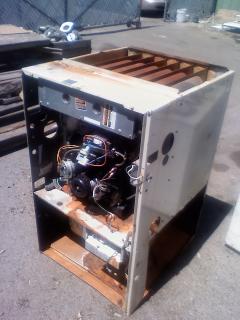
The pictured Carrier furnace is only seven years old. This furnace had to be replaced early, due to a condensate drain, which had become plugged with dirt and attic insulation. This caused water to drain inside the unit for many years until it failed. The damage, due to neglect, voided the manufacturer’s warranty on the furnace. This could have been easily prevented with a routine maintenance service performed by J.C. Melton Air Conditioning.The equipment had not been maintained since the original installation. Because of the irreparable damage to the furnace, the customer had to purchase a new furnace at his own cost. This furnace should have been able to give good service for fifteen-twenty years.
Don’t let, what would have been an inexpensive preventative maintenance repair, cost you a new system.
Call J.C. Melton Air Conditioning today!
- Is the Melton Care Preferred Customer maintenance plan a contract that binds me?
No, the Melton Care Preferred Customer Plan (MCPC) is not a contract. It is a non-binding semi-annual maintenance agreement that covers two visits per year: one in spring before cooling season and one in fall before heating season (or fall/spring, depending on when you start). To receive the discounted maintenance rate, both visits are paid for at the first visit. Customers who maintain their equipment continuously under the MCPC receive additional benefits outlined in the Products and Services section. The plan exists to make it easy for homeowners to stay on a consistent maintenance schedule without the commitment of a long-term contract, you are not locked in, and there is no penalty for discontinuing. JC Melton recommends semi-annual service for all residential HVAC equipment to prevent unexpected breakdowns, extend equipment lifespan, and keep manufacturer warranties valid.
- What is a whole house fan?
A whole house fan is a ventilation system installed in the ceiling between the living space and the attic. It works by drawing cool outside air in through open windows and doors and pushing the hot air out through the attic vents. Whole house fans are most effective during the cooler morning and evening hours in Fresno, typically before 10am and after 7pm, when outside temperatures drop below the indoor temperature. Running a whole house fan during these windows can pre-cool the home before the day heats up, reducing how hard the air conditioner has to work and lowering energy costs. JC Melton installs whole house fans including Quiet Cool models, which are significantly quieter and more energy-efficient than older designs. Installation costs typically range from $2,500 to $3,000 depending on equipment, and most installations are completed in approximately one full day (8 hours).
- What is the cost to have a whole house fan installed?
Usually between $2,500.00 – $3,000.00 depending on equipment.
The new Quiet Cool fans do cost more, however, they are much quieter and more efficient than the older models.
- What is an attic fan?
An attic fan is either an electrically- or solar-powered fan installed in the attic which pulls in cool air and exhausts the hot air from the attic.
General costs for attic fans are: $600.00 for electrical-powered attic fans
- How long does it take to install an attic fan?
Attic fan installation by JC Melton Air Conditioning typically takes approximately half a day — about 4 hours. The installation involves mounting the fan unit in the attic, wiring the electrical connection (for electric-powered models), and verifying proper operation before the technician leaves. JC Melton installs both electrically-powered attic fans and solar-powered attic fans. Electric-powered attic fan installations are generally priced at $600. The attic fan itself is installed in the attic space and exhausts hot air that builds up during the day, reducing the load on the air conditioning system and helping the home cool down faster in the evening. If you are deciding between an attic fan and a whole house fan, a JC Melton consultant can explain the difference and recommend the right fit for your home. Call (559) 268-6286 to schedule.
- Why would I want to change from Gas Electric to all Electric Heat Pump?
Some of our customers appreciate the Carbon Free (Green) method of heating their house. Others, who have Solar Panels on their home/business that supply all (or almost all) the power their home uses, would have the benefit of heating their buildings with the extra electricity the panels produce after installing a high efficiency system. (Please note that Heat pumps take noticeably longer to heat the home than Gas furnaces would have done as they have lower heat capacity at one time.)
- What is the Difference between my old Gas Furnace with Electric Cooling and a Heat Pump System?
A Gas fired furnace creates heat by burning natural gas or propane and distributing the heat to the house. The Electric Air Conditioner takes heat from the house air (cooling the house) and gets rid of it to the outside air.
A Heat pump System (all Electric) is an Air conditioner that can run backwards. Instead of moving the heat from inside to outside (like in the summer), it reverses operation and moves heat from outside air to the inside air (heating the house)
- How long does the average Split System (Condensing unit outside and Furnace/Evaporator inside) replacement take?
Average duration is 3 days with testing. Existing Equipment removal and reinstallation of new begins Day 1. Equipment is usually up and running in whatever season is called for (Heating or Cooling) Day 2. Day 3 is for completion of replacement and System and Ductwork condition Testing. (please note Duct repairs will add time to the project.)
- How long does the average Packaged Equipment (Rooftop Unit) system take?
Average duration is 2 days with testing. The Equipment is usually up and running in whatever season is called for (Heating or Cooling) on day 1. The second Day is for completion of replacement and System and Ductwork condition Testing. (please note Duct repairs will add time to the project.)